
Testing Innovative Packaging Materials in the CircSyst Project


 Link Copied!
Article written by Dr. Kata Konstantin, MGFÜ
The development of sustainable packaging solutions is one of the key areas of the circular economy. Within the CircSyst project, Ugrinpack and Szimbio Lab are not only working on the introduction of already available environmentally friendly packaging alternatives, but also on the development and testing of new, innovative materials. For this reason, during the first half of the project, significant emphasis was placed on examining alternative packaging materials, with particular attention to bio-based and biodegradable solutions.
The systematic testing of alternative packaging materials began with the involvement of accredited external laboratories. One important focus of the tests was the examination of PHA-based materials. PHA, or polyhydroxyalkanoate, is a biologically derived polymer that may represent a potential alternative to conventional plastics.
During the experiments, different manufacturing technologies were tested. Although the production of blown film did not prove successful, films produced using cast film technology, as well as the production of thermoformed cups, proved to be feasible. The experience gained during the tests shows that PHA has favourable properties; however, its market availability in industrial quantities is currently still limited. Suppliers were only able to provide smaller, experimental quantities, which at present hinders broader industrial application. The results of the research will be used in the further development activities of the project, especially in the work packages focusing on PHA.
Development of mycelium-based packaging
During the project, Ugrinpack also explored new cooperation opportunities in the field of sustainable packaging material development. Together with Márföldi Dóra, a researcher at Szimbio Lab, a potential cooperation was outlined in connection with a project funded by the German Federal Environmental Foundation (DBU).
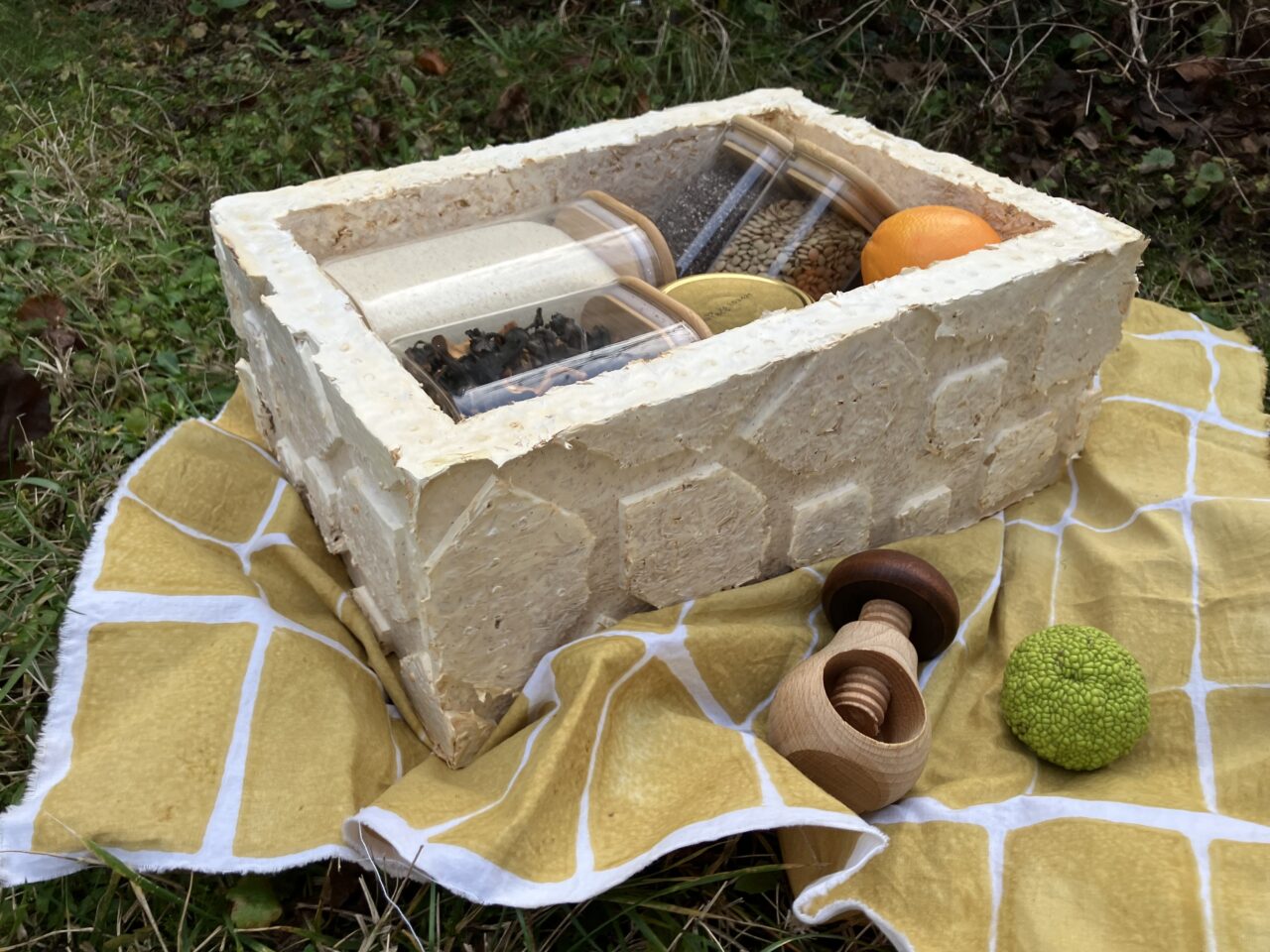
Within the framework of this cooperation, an opportunity emerged to jointly examine the development of mycelium-based packaging materials. Mycelium — the underground, thread-like structure of fungi — can be combined with agricultural waste materials to produce various packaging elements. The advantage of these types of materials is that they are compostable and their production involves a relatively low environmental burden. The planned joint development work will cover a six-month period and may contribute to further expanding the range of sustainable packaging alternatives.
Waste Management and Circularity Assessment
Within the project, not only the development of new packaging materials but also the assessment of their life cycle plays an important role. As part of this, the project partners are also monitoring the management of packaging waste and its compatibility with existing recycling systems.
One example of the practical tests was the Grill Festival held in Üröm on 22 March 2025, where biodegradable catering products provided by Ugrinpack were used. The event provided an opportunity to document the handling of compostable packaging materials in a real-life environment.
Digital tracking devices were also installed in waste collection containers to monitor waste streams. The data collected in this way contribute to the life cycle assessment (LCA) of the packaging materials and support the evaluation of the environmental impacts of alternative packaging solutions.
These activities within the CircSyst project represent an important step towards making an increasing number of sustainable packaging solutions applicable at both industrial and commercial levels in the future.