Rethinking value chains for a nature-positive circular economy: key takeaways from the CSSBoost event


 Link Copied!
Article written by Carla Buonamisis, EURADA
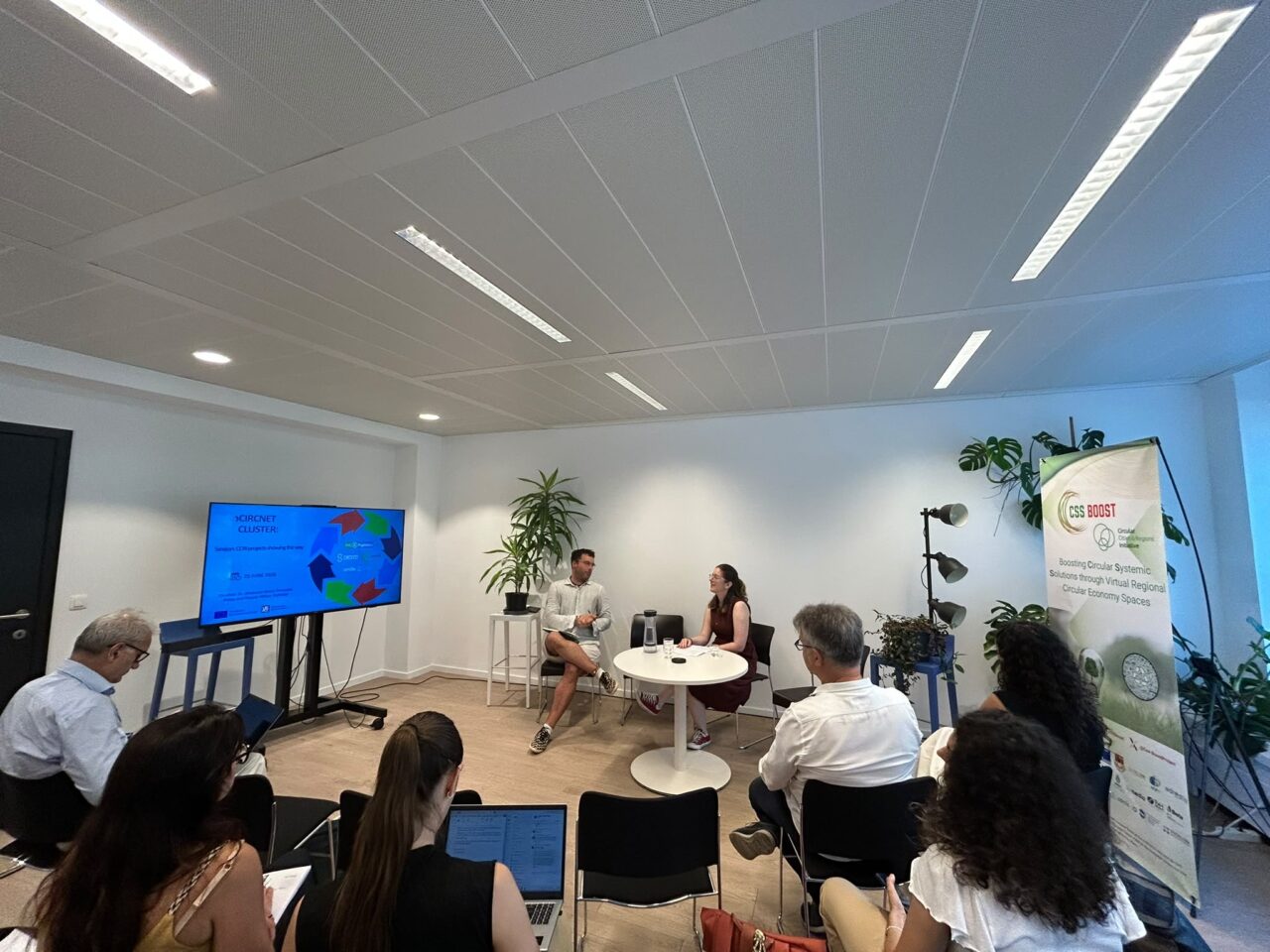
On 25 June 2026, CSSBoost organised the side event “Rethinking value chains for European nature-positive economy” under the umbrella of the European Green Week, bringing together stakeholders working on circular economy implementation across Europe. As part of the CIRCNET Cluster, CircSyst participated together with other sister projects, namely SMILE City and FIC-Fighters, contributing to the exchange on how to move from circular ambition to real implementation.
The discussions highlighted that the circular economy progress in Europe is mainly driven by waste management, while prevention and systemic change remain more limited. Many circular business models are still quite isolated and focused on internal optimisation, which can limit their wider impact.
The first session, entitled “CCRI projects showing the way“, included interventions from all sister projects presenting different perspectives on systemic circular innovation. Representing CircSyst, project coordinator Joaquín Vilaplana (AIJU) presented the project’s progress in advancing circular solutions, with a particular focus on the plastics and packaging value chain and the developments achieved in the Valencian Community. He also introduced the CircSyst Community of Practice as a collaborative space for knowledge exchange, stakeholder collaboration, and the promotion of systemic circular solutions. This was followed by similar interventions from the sister projects, who highlighted different approaches to circularity including skills development, social innovation, community engagement, and the need for mainstreaming circular solutions.
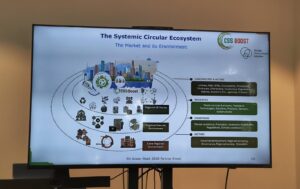
Across the sessions, a recurring message appeared: scaling circularity only becomes possible when the surrounding ecosystem is aligned. Even the most innovative solutions struggle to expand if governance, markets and stakeholders are not coordinated. Within this context, the importance of real demand was also evident, as several examples showed that solutions rarely move beyond the pilot phase without market interest and alignment with consumer needs.
From a more technical perspective, benchmarking circular business models was also highlighted as a key element for scaling. The discussion stressed that projects need to demonstrate not only environmental impact, but also operational feasibility and financial logic to support their adoption. In this context, public procurement, de-risking instruments and stronger coordination across the value chain were mentioned as crucial to making circular solutions more “bankable” and easier to replicate.
Regional insights from Wallonia and Alentejo reinforced the idea that circular economy implementation is highly place-based. While many regions have already built strong innovation ecosystems, a key challenge is still how to scale what already exists and make ongoing initiatives more visible and better connected. Overall, the event reinforced a common understanding: circular transition is not just about individual projects but about creating the conditions that allow them to grow, connect, and survive beyond the pilot stage.
Upon the event’s conclusion, the CIRCNET cluster, bringing together CircSyst (represented by EURADA), CSSBoost, FIC-Fighters and SMILE City, held its fourth in-person meeting. During the meeting, partners discussed the achievements and progress so far as well as the development of a short webinar series dedicated to the projects’ key value chains. The series will consist of four episodes, showcasing practical experiences, lessons learned and collaborative approaches to advancing circular economy implementation across Europe. More information will be shared in the coming months, with the initiative set to kick off in autumn 2026.