
Highlights from CircSyst’s Biowaste Replication Workshop


 Link Copied!
Article written by Cristina Sanz Rutherford, Policy and Project Officer at Eurada
CircSyst held its first replication workshop and study visit on 5–6 November 2025 in Lahti, Finland, bringing partners together to explore how the project’s circular systemic solutions (CSS) can be transferred across regions and value chains. Hosted by LAB University of Applied Sciences, the event marked the launch of a series of replication-focused workshops designed to promote peer learning, share practical experiences, and identify the key enablers and challenges for scaling CircSyst’s nine holistic circular models.

Photo: Edina Tóth
On 5–6 November 2025, CircSyst held its first replication workshop and study visit in Lahti (Finland), organised back-to-back with the project’s third General Assembly. Focused on biowaste Circular Systemic Solutions (CSS) and hosted by LAB University of Applied Sciences, this workshop was the first of a series of replication-focused events – one per value chain – coordinated by EURADA. As CircSyst develops and tests nine holistic circular models, ensuring that these solutions can be replicated beyond their local contexts is a priority. Therefore, these workshops aim to explore the transferability of the project’s CSS across regions and value chains, while fostering peer learning, experience-sharing, and identifying the barriers and drivers for their replication.
The event engaged 66 participants, both in person and online, including project partners, members of the Community of Practice (CoP), and other interested stakeholders. Together, they explored how lessons from CircSyst’s two biowaste demonstrators, namely Finland’s flexible and intelligent biorefinery and Spain’s circular beer industry demonstrator, can inspire replication in territories facing similar needs, challenges, and opportunities.

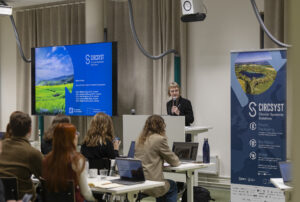
Photo: Samu Riitala
The programme began with a brief overview of the project by Joaquín Vilaplana (AIJU), followed by Katerina Medkova (LAB), who set the scene of the session with good practices in circular bioeconomy. Demonstrator partners then shared their work: María del Puig Vicente Viñas (UPV) and Jose Bas (Cabka) presented the valorisation of bagasse waste, demonstrating how brewery residues can be transformed into high-value biobased materials, while Merja Kontro (University of Helsinki) showcased the mobile and modular biorefinery being tested in Finland, converting biowaste streams into PHAs, nutrients, and other recovered outputs.

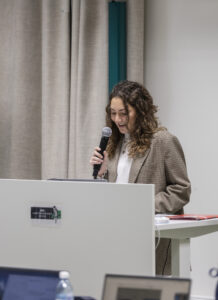

Photo: Samu Riitala
A highlight of the programme was the intervention from the Community of Practice, offering a complementary perspective on waste management: that of prevention and citizen engagement. Representing Taste Before You Waste (TBYW), Tiffany Flaherty showcased how community-driven action in Amsterdam prevents edible food from becoming waste. Her intervention offered a valuable reminder that prevention and valorisation are two complementary pillars of circularity. TBYW rescues food before it enters the waste stream — and for the fraction that can no longer be consumed, solutions such as those developed by our CircSyst biowaste demonstrators can provide a new life through recovery, transformation, and resource regeneration. This upstream-to-downstream continuum reflects the very essence of a circular, sustainable system, where community engagement and technological innovation reinforce one another.

Photo: Samu Riitala
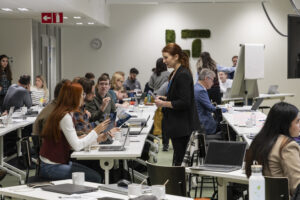
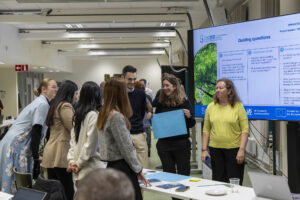
Participants then engaged in an interactive peer exchange session, working in groups to reflect on what aspects of the demonstrators could be replicated, which elements would require adaptation, and what context-specific barriers may hinder the uptake of biowaste solutions in different regions. Insights were later shared in plenary, helping consolidate lessons learned and highlighting the multi-stakeholder collaboration behind all the presented solutions, which reminded us that circular innovation relies on a board ecosystem of actors, because no single actor can close the loop alone. All in all, participants gained practical insights into circular biowaste management, discussed enabling conditions for replication, and had a chance to connect with experts and innovators from across Europe.

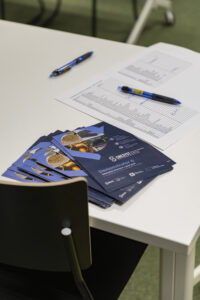
Photos: Samu Riitala
Finally, in addition to the workshop and study visits, this gathering also marked the third General Assembly. This served as an occasion for consortium partners to share insights from their work for the past 18 months and reflect on the progress of the overall project, already halfway through its lifetime. Work Package and Demonstrator leaders presented updates on their technical work, while transversal partners presented their progress on communication, dissemination, knowledge transfer, replication, policy and exploitation matters. The discussions confirmed not only the steady technical progress of the project, but also the increasing synergy among partners as CircSyst moves forward.

Photo: Edina Tóth